
Home Health Aide Practice Test HHA Exam Prep Free Questions 100 Pass Rate Guide

Passing the Home Health Aide exam starts before test day. It starts with the right practice questions, timed exams, and study materials that help the information feel familiar instead of overwhelming.
Diamond School of Nursing’s Home Health Aide program is built for that exact goal. The program helps students learn core HHA skills, review exam topics, and build confidence with free practice tests and exam prep resources. With 500+ practice questions, full-length timed exams, a 1,200+ question bank, and an impressive 100% first-try pass rate, it gives future aides a clear path from studying to passing.
If you are searching for a Home Health Aide practice test, reliable HHA exam prep, or Free HHA Practice Questions that actually match what students need to know, this guide explains how Diamond School of Nursing supports exam readiness from start to finish.

What a Home Health Aide does
A Home Health Aide, often called an HHA, helps people with daily care in a home setting. HHAs often support older adults, people with disabilities, and patients recovering from illness or injury.
Common HHA duties may include:
Helping with bathing, dressing, grooming, and hygiene
Supporting safe movement around the home
Preparing light meals
Reminding clients about care routines
Observing changes in condition
Reporting concerns to a supervisor or nurse
Maintaining a clean and safe living space
The role requires patience, communication, safety awareness, and basic knowledge of personal care. Because HHAs often work closely with clients and families, training matters. A strong program helps students learn both the care skills and the judgment needed for safe support.
What an HHA practice test is
An HHA practice test is a study tool that lets students answer sample questions before taking the actual exam. A good practice test does more than show whether an answer is right or wrong. It helps students understand the topic, recognize weak areas, and get used to the pace of the exam.
A Home Health Aide practice test usually covers subjects such as:
Infection control
Personal care
Client rights
Safety and emergency response
Communication
Nutrition and hydration
Basic body systems
Range of motion and mobility
Observation and reporting
Professional boundaries
Practice tests are useful because they turn studying into active recall. Instead of only reading notes, students have to choose answers, compare options, and think through real care situations.
That kind of practice can make test day feel less stressful.
Why Diamond School of Nursing’s HHA program stands out
Diamond School of Nursing’s HHA program is designed to help students prepare with structure, repetition, and practical review. The goal is not only to complete training. The goal is to understand the material well enough to pass with confidence and apply it in real care settings.
Diamond School of Nursing reports a 100% first-try pass rate for its HHA students, supported by practice exams, study materials, and a large question bank.
That pass rate matters because first-time success can save time, reduce stress, and help graduates move forward sooner.
The program includes 500+ practice questions
Practice questions help students move from “I read this” to “I can answer this.” Diamond School of Nursing provides 500+ practice questions so students can review many exam topics in different formats.
This matters because HHA exams often test the same concepts in different ways. A student may understand infection control in one question, then get confused when the same topic appears in a scenario about handwashing, gloves, or cleaning supplies.
More practice helps close that gap.
Students can use full-length timed exams
Timed exams help students practice the full test experience. They build stamina, improve pacing, and reduce surprises.
A full-length timed exam helps students learn:
How long to spend on each question
When to move on and return later
How to stay calm under time pressure
Which topics need more review
How the actual exam may feel
Timed practice is especially helpful for students who know the material but feel anxious during tests. Rehearsing the format can make the real exam feel more familiar.
The 1,200+ question bank supports deeper review
A large question bank gives students room to keep practicing without seeing the same questions too often. Diamond School of Nursing’s 1,200+ question bank gives students access to broad review across key HHA exam topics.
That range helps students avoid memorizing only a small set of answers. Instead, they can learn patterns, improve reasoning, and build stronger understanding.
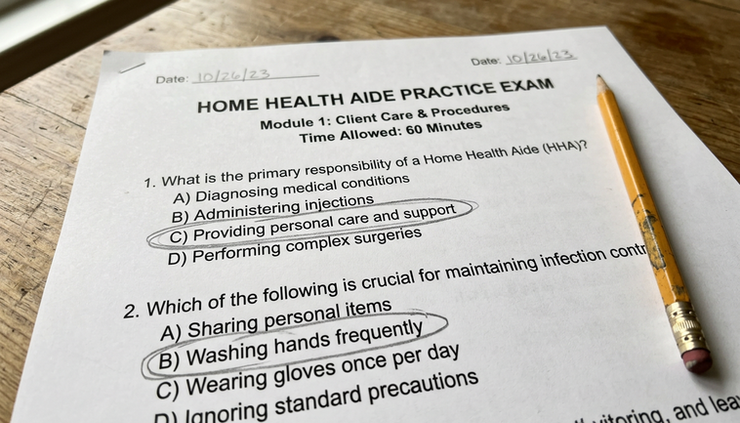
How HHA exam prep helps students pass the first time
Good HHA exam prep brings together content review, practice questions, and test-taking strategy. It helps students know what to study and how to study it.
Diamond School of Nursing’s approach supports exam readiness in several ways.
It builds confidence through repetition
Confidence comes from seeing progress. A student who misses questions on infection control can review that topic, try similar questions, and watch scores improve.
That repetition reduces guessing. It also helps students trust their training when they face a new question on the exam.
It connects classroom learning to real care situations
HHA exams often include scenario-based questions. These questions ask what an aide should do first, how to respond to a client, or when to report a problem.
For example, a question may describe a client who suddenly feels dizzy while walking. The answer depends on safety, observation, communication, and reporting. Practice questions help students learn how to think through those moments.
It helps students study with a plan
Studying everything at once can feel overwhelming. A practice test shows what needs attention.
A simple study plan may look like this:
Take a short practice quiz.
Review missed questions.
Study the related topic.
Take another quiz on that topic.
Complete a timed exam.
Repeat until scores improve.
This cycle keeps studying focused. It also makes progress easier to measure.
Free practice tests and study materials can make preparation easier
Cost should not be the reason a student skips practice. Free resources can give students a starting point and help them build a daily study routine.
Diamond School of Nursing highlights free practice tests and exam prep resources for HHA students, including study materials, sample questions, and test-style review. These tools are especially useful for students who want to prepare before class, review after class, or test themselves before exam day.
A Free HHA Practice exam can help students understand the question style, while the larger question bank supports longer-term practice.
Useful study materials may include:
Topic summaries
Vocabulary lists
Care procedure reviews
Practice quizzes
Timed test simulations
Answer explanations
Safety and infection control refreshers
The best study resources are clear, simple, and connected to real HHA duties.
Key topics covered in a strong HHA practice test
A strong practice test should reflect the knowledge used in home care. The exam is not only about memorizing terms. It is about knowing how to support clients safely and respectfully.
Infection control and standard precautions
This topic often includes hand hygiene, glove use, cleaning, and preventing the spread of infection. HHAs must understand when to wash hands, when to wear gloves, and how to protect both the client and themselves.
Client rights and communication
Clients have the right to privacy, dignity, choice, and respectful care. Practice questions may ask how to respond to a client who refuses care or how to protect confidential information.
Safety and emergency response
Safety questions may cover falls, fire safety, choking, dizziness, burns, and unsafe home conditions. Students should know when to act, when to call for help, and when to report concerns.
Personal care skills
Personal care topics include bathing, dressing, grooming, mouth care, toileting, and skin care. These questions often focus on comfort, privacy, and proper technique.
Nutrition, hydration, and observation
HHAs may help with meals and fluids, depending on the care plan. They also observe changes, such as poor appetite, confusion, swelling, pain, or skin changes.
These observations matter because HHAs often notice changes first.

State-specific HHA exam prep and practice test searches
HHA requirements can vary by state, employer, and program type. Some students need state-approved training, while others need employer-based training or certification tied to specific care settings. Always check current requirements for the state where care will be provided.
Many students search for state-specific practice help. Diamond School of Nursing’s study resources can be useful for broad exam readiness, especially when paired with local state requirements.
Common state-specific search terms include:
State | Common search phrase |
Florida | Florida HHA practice test |
New York | New York Home Health Aide practice test |
California | California HHA exam prep |
Texas | Texas Home Health Aide exam prep |
New Jersey | New Jersey HHA practice questions |
Pennsylvania | Pennsylvania Home Health Aide practice exam |
Georgia | Georgia HHA exam study guide |
Illinois | Illinois HHA practice test |
North Carolina | North Carolina Home Health Aide exam prep |
Ohio | Ohio HHA practice questions |
Students in states such as Florida, New York, California, Texas, New Jersey, Pennsylvania, Georgia, Illinois, North Carolina, and Ohio may see different program rules. The core care topics are often similar, but state expectations can differ.
That is why a strong HHA exam prep plan should include both general practice and state-specific review.
How to use the 1,200+ question bank effectively
A large question bank is valuable, but only if it is used with a plan. Answering hundreds of questions without review can lead to repeated mistakes. The best approach combines practice with reflection.
Start with a baseline quiz
Begin with a short quiz before reviewing notes. This shows current strengths and weak areas. Do not worry about a low first score. The goal is to find out where to begin.
Review every missed question
Missed questions are the most useful study tool. For each one, ask:
What topic was tested?
Why was my answer wrong?
What clue did I miss?
What rule or care principle should I remember?
This process turns mistakes into learning.
Mix short quizzes with timed exams
Short quizzes help with topic review. Full-length timed exams help with endurance.
Use both. A balanced plan may include short quizzes during the week and a full timed exam once or twice before the real test.
Track problem topics
Keep a simple list of topics that need more work. Infection control, safety, and client rights are common areas for review because they appear in many care scenarios.
When scores improve in those areas, confidence usually improves too.
Why first-time pass results matter
A 100% first-try pass rate is a strong sign that students are getting the support they need. It suggests the program is helping students prepare before the exam, not just giving them material and hoping they figure it out.
First-time passing matters because it can help graduates:
Move toward employment sooner
Avoid retesting delays
Reduce exam stress
Build confidence for client care
Feel ready for the next step in a healthcare career
For many students, HHA training is also a starting point. Some later move into CNA training, practical nursing, registered nursing, or other healthcare roles. A strong first training experience can make that path feel more possible.

FAQ about Home Health Aide practice tests and HHA exam prep
What is the best way to prepare for the HHA exam?
The best way to prepare is to combine study materials, practice questions, and timed exams. Review core topics first, then use practice tests to find weak areas. Diamond School of Nursing supports this with 500+ practice questions, full-length timed exams, and a 1,200+ question bank.
Are free HHA practice questions enough to pass?
Free practice questions can help a lot, but they work best as part of a broader study plan. Students should also review explanations, study care procedures, and take timed exams to prepare for the test format.
What topics are usually on a Home Health Aide practice test?
Most practice tests include infection control, safety, personal care, client rights, communication, nutrition, mobility, and observation. Some questions may use real-life care scenarios.
How many HHA practice questions should I complete before the exam?
There is no single number that fits everyone. A good goal is to answer enough questions to see steady improvement. Diamond School of Nursing’s 500+ practice questions and 1,200+ question bank give students plenty of room to practice.
Do HHA exam requirements vary by state?
Yes. Requirements can vary by state, employer, and care setting. Students should check current rules in their state while using practice tests to strengthen general HHA knowledge.
Can timed exams reduce test anxiety?
Yes. Timed exams help students get used to the pace and pressure of the real test. Practicing under similar conditions can make exam day feel more familiar.
Why does a 100% first-try pass rate matter?
It shows that students are preparing well before taking the exam. A first-time pass can save time, prevent retesting stress, and help students move forward faster.
Who should use Diamond School of Nursing’s HHA exam prep resources?
The resources are useful for students entering HHA training, current students preparing for the exam, and anyone reviewing home care basics before starting work.
A strong HHA exam prep plan starts with the right practice
Home care is personal, practical, and important work. The exam is one step toward that responsibility, and preparation should feel clear rather than confusing.
Diamond School of Nursing’s Home Health Aide program gives students a strong foundation with free practice tests, study materials, 500+ practice questions, full-length timed exams, and a 1,000+ question bank. The reported 100% first-try pass rate adds one more reason to take the preparation seriously.
For anyone getting ready to become a Home Health Aide, the next step is simple: study the core topics, take practice tests often, review every missed question, and build confidence one exam session at a time.
5 Free HHA Practice Questions (With Rationales)
These questions reflect the style and content of a real Home Health Aide certification exam.
Question 1 A home health aide arrives and notices the client is confused and has slurred speech that was not present at the last visit. What is the priority action?
A) Encourage the client to rest and check again in an hour
B) Report the change immediately to the supervising nurse
C) Give the client water and wait for improvement
D) Document the finding and continue with the scheduled visit
Correct Answer: B Sudden confusion and slurred speech are signs of a possible stroke or acute neurological change. HHAs must report changes in a client's condition immediately so the supervising nurse can assess and escalate care.
Question 2 When assisting an elderly client with a tub bath, the HHA should:
A) Leave the client alone to preserve their privacy
B) Stay with the client throughout the entire procedure
C) Fill the tub as full as possible for comfort
D) Use the hottest water the client requests
Correct Answer: B Elderly clients are at high risk for falls and slipping. The HHA must remain present at all times. Water temperature should be tested at around 105°F to prevent burns.
Question 3 Which hand hygiene practice is correct for an HHA before providing personal care?
A) Wipe hands with a paper towel only
B) Rinse hands with cold water for five seconds
C) Wash hands with soap and water for at least 20 seconds
D) Use hand sanitizer only, regardless of visible soiling
Correct Answer: C Hand washing with soap and water for at least 20 seconds is the standard for infection control before and after direct client care. Hand sanitizer is acceptable when hands are not visibly soiled, but soap and water is preferred in direct care settings.
Question 4 A client tells the HHA that her son hit her last night. What must the HHA do?
A) Tell the client to speak with her doctor at the next appointment
B) Advise the client to call the police herself
C) Do nothing, as family matters are private
D) Report the disclosure to the supervising nurse immediately
Correct Answer: D HHAs are mandated reporters. Any disclosure or suspicion of elder abuse must be reported to the supervising nurse immediately, who will follow the agency's mandatory reporting protocol.
Question 5 An HHA measures a client's blood pressure as 88/54 mmHg. The client appears pale and reports feeling dizzy. What is the correct action?
A) Recheck the blood pressure in 30 minutes
B) Encourage the client to stand up and walk around
C) Report the findings immediately to the supervising nurse
D) Document the reading and continue with care
Correct Answer: C A blood pressure of 88/54 mmHg is significantly low. Combined with pallor and dizziness, this indicates possible hypotension requiring immediate nursing assessment. Encouraging ambulation could cause a fall.
Want the full 500+ question bank with instant rationales and performance tracking? Start free at Diamond School of Nursing.
Frequently Asked Questions
What is the Home Health Aide exam?
The Home Health Aide exam is a competency evaluation that tests knowledge and skills in providing safe, dignified personal care to clients at home. It typically includes a written or oral knowledge test and may include a practical skills demonstration. Requirements vary by state and certifying body.
Is the HHA exam hard?
The HHA exam is challenging but very passable with the right preparation. Diamond School of Nursing reports a 100% first-try pass rate among students who complete the full HHA Study Hub program.
How many questions are on the HHA exam?
Most written HHA competency exams range from 50 to 100 questions, though the exact count varies by state and certifying body. Diamond School of Nursing's practice exams are timed and structured to match real state exam formats.
Can I take HHA practice tests online for free?
Yes. Diamond School of Nursing offers a completely free HHA practice test at diamondnursingschool.com/study-hub-programs/home-health-aide. You can try 70 questions immediately without an account. A free account unlocks the full 1,200+ question bank, timed exams, flashcards and a state-specific study guide.
What score do I need to pass the HHA exam?
Most states require a score between 70% and 80% to pass the written component. Practical skills are typically graded pass/fail per skill. Check your state's specific requirements before your exam date.
How long does it take to prepare for the HHA exam?
Most candidates spend two to four weeks studying with a consistent daily practice plan. Students who use exam-aligned questions with clinical rationales tend to feel ready faster than those who study from textbooks alone.
What is the difference between an HHA and a CNA?
A Certified Nursing Assistant (CNA) works primarily in nursing homes, hospitals and long-term care facilities. A Home Health Aide works in a client's private residence and typically has a narrower clinical scope. CNAs generally receive more clinical training and may perform certain procedures outside an HHA's scope of practice.
Do I need to renew my HHA certification?
Most states require periodic renewal, which may include continuing education hours or a competency re-evaluation. Check with your state's health department or licensing board for current requirements.
Start Studying Right Now
You can try 70 HHA practice questions immediately without creating an account. When you're ready for the full 1,200+ question bank, personalized analytics, timed full-length exams and a state-specific study guide, a free account takes under a minute.
Join 1,000+ students who already passed their exam with Diamond School of Nursing.
Built by nurses. Free for everyone. All 50 states covered. Diamond School of Nursing | HHA Study Hub


Comments